Living Near the Sea in Montevideo (2026): Neighborhoods and Costs
INGAR · · Neighborhoods
Summary
Montevideo's Rambla stretches 22 kilometers of coastline and, if you browse listings, it can seem like living "by the sea" is a luxury reserved for a few. The reality is more nuanced: there are stretches where the price per square meter starts at USD 2,900 and others where it exceeds 4,400. And there is an enormous difference between being on the Rambla and being three blocks away from it.
In this guide we break down the six coastal neighborhoods of Montevideo with real market prices, the hidden costs almost nobody tells you about (salt air, humidity, southerly wind, noise) and a conclusion that many buyers discover too late: living 2-3 blocks from the Rambla gives you 90% of the coastal lifestyle at 60-70% of the price, without the maintenance headaches.
If you already have a neighborhood in mind, you can go directly to the specific guide:
1) Montevideo's Coastal Map: Six Neighborhoods, Six Profiles
The Montevideo coastline is not uniform. The urban profile changes, the demographic changes, the price changes and even the water quality changes. Traveling it from west to east is like crossing different cities in 22 kilometers.
Rambla Sur / Parque Rodó (~USD 2,900/m2)
This is the most accessible entry point to coastal living. From the Cerro breakwater to Parque Rodó, the Rambla Sur concentrates 1950s–70s buildings with generous floor plans and prices that, per square meter, are the lowest along the entire coastal strip. A two-bedroom apartment of 70 m2 in good condition can be found around USD 200,000–210,000.
The Palermo–Parque Rodó stretch offers the best of both worlds: coast and centrality. You are ten minutes' walk from the Centro, close to the Mercado del Puerto, the Tristán Narvaja fair on Sundays and a growing restaurant scene. Parque Rodó itself is a green lung that adds value to the area.
The upside: low entry price, proximity to the Centro, generous floor plans, culture and dining within walking distance.
What you need to know: many buildings need serious maintenance (look at the facades before going inside). The Ciudad Vieja area along the Rambla has security concerns that vary greatly from block to block. And the southerly wind hits full force: there is nothing to stop it between the Río de la Plata and your window.
Pocitos Rambla (~USD 4,000+/m2)
The classic. Pocitos beach is Montevideo's most iconic image and the neighborhood where the real estate market has the most liquidity. An apartment on the Pocitos Rambla with sea views starts at USD 4,000/m2 and can exceed USD 5,000 in new towers or high floors with unobstructed views.
Demand is sustained because Pocitos offers everything: beach, services, transport, dining, schools. That makes it a safe bet for resale, but also means you pay a considerable premium for that security.
The upside: maximum resale liquidity, full services, dense public transport, Montevideo's most "urban" beach.
What you need to know: HOA fees on the Rambla are high (24-hour concierge, maintenance of salt-air-exposed facades, elevators). Parking is a chronic problem. And the Pocitos Rambla is noisy: it is a heavy-traffic road, not a pedestrian promenade. If your bedroom faces the Rambla, you will need good-quality windows.
Buceo / Puerto del Buceo (~USD 4,000+/m2)
Buceo underwent a quiet transformation over the last decade. The area around Puerto del Buceo and Rambla Armenia filled up with new towers featuring amenities, and prices reached parity with Pocitos. The marina gives it a particular character: views of sailboats instead of sand.
The neighborhood has a younger, less "established" profile than Pocitos, with quality developments and interesting restaurant growth along Calle Pagola and surroundings.
The upside: newer construction than Pocitos (better insulation, better materials), marina, sustained neighborhood growth.
What you need to know: unlike Pocitos, there is no proper beach in the marina area. The Rambla del Buceo receives strong southeast winds. And new towers have high HOA fees due to amenities (pool, gym, function room). Always ask for the actual HOA amount before falling in love with the view.
Malvín (~USD 3,500/m2)
Malvín is the coastal neighborhood that best balances price and quality of life. Malvín beach is one of Montevideo's most used beaches (and one of the best in IMM water quality analyses). The neighborhood has a strong residential character, with houses and low-rise buildings that give it a human scale that Pocitos lost long ago.
At an average of USD 3,500/m2 on the Rambla, Malvín offers a significant price difference from Pocitos, with a beach experience that many consider superior.
The upside: good-quality beach, residential neighborhood with identity, more affordable prices than Pocitos/Buceo, good connectivity (buses along Giannattasio, Rivera, Italia).
What you need to know: fewer dining and service options than Pocitos (though this is improving). The Rambla stretch between Buceo and Malvín has strong crosswinds. And as along the entire coast, humidity is the silent enemy.
Punta Gorda (~USD 3,700+/m2)
Punta Gorda is where Montevideo's coast starts to feel more "suburban." Houses with gardens, quieter streets, less traffic. The profile is established families and retirees who prioritize tranquility over activity.
The area has a particular charm: the actual point (where the Rambla turns) offers panoramic views that exist nowhere else along the coast. The sunsets from there are on another level.
The upside: tranquility, consolidated residential profile, exceptional views at the point, less traffic noise than Pocitos.
What you need to know: you depend more on a car (less public transport, fewer walkable shops). Prices have risen steadily and are no longer the "economic alternative" they once were. The wind at the point itself is brutal; buildings along that curve of the Rambla require constant facade maintenance.
Carrasco (~USD 4,400+/m2)
The most expensive neighborhood on the Montevideo coast. Carrasco combines the Rambla with an urban fabric of stately homes, dense tree cover and a high socioeconomic profile. Carrasco beach is wide and, being further east, the water quality is generally better than in the city center.
Here the price per square meter on the Rambla comfortably exceeds USD 4,400, and in the interior blocks of Carrasco Sur prices are also high due to the neighborhood's prestige.
The upside: maximum prestige, wide beach, tree cover, high perceived safety, proximity to the airport.
What you need to know: it is the most expensive neighborhood, period. Property taxes (Contribución Inmobiliaria) are proportionally higher. Car dependence is total: there is practically nothing walkable outside Carrasco Shopping. And the distance to downtown Montevideo is a real factor if you work there (30–40 minutes in peak hour).
2) Comparative Price Table by Coastal Neighborhood
These are market averages for apartments in good condition, updated to early 2026. The "2-3 blocks" column shows the typical discount for stepping back just one block from the waterfront:
| Coastal neighborhood | USD/m2 on Rambla | USD/m2 2-3 blocks | Approx. discount |
|---|---|---|---|
| Rambla Sur / Parque Rodó | ~2,900 | ~2,200–2,500 | 15–25% |
| Pocitos Rambla | ~4,000+ | ~2,800–3,200 | 20–30% |
| Buceo / Puerto | ~4,000+ | ~2,700–3,100 | 20–30% |
| Malvín | ~3,500 | ~2,600–2,900 | 17–25% |
| Punta Gorda | ~3,700+ | ~2,800–3,100 | 15–25% |
| Carrasco | ~4,400+ | ~3,400–3,800 | 15–22% |
Note: these are indicative market values. The actual price of each property depends on floor, condition, view, building age and dozens of other variables. If you want a more precise reference for a specific area, our automated valuation tool gives you an estimate based on real market data.
3) First Line vs. Three Blocks: The Decision That Saves You the Most Money
This is the central point of this article, and we say it with data: the difference between living on the Rambla and living three blocks away is much greater in price than in life experience.
What you gain on the first line
- The view. There is no substitute. Waking up with the Río de la Plata in front of you is something that cannot be replicated three blocks away. If the view is your number-one priority, you need to be on the Rambla.
- Immediate access. Cross the street and you are on the Rambla. For running, walking or cycling, you do not even travel half a block.
- Resale value. Sea-view properties have sustained demand and historically hold their value better.
What you pay on the first line (and many people do not calculate)
This is where things get interesting, because the real cost of living on the Rambla is not just the purchase price.
Salt air. The saline air from the Río de la Plata is corrosive. It attacks aluminum window frames, outdoor air-conditioning units, metal railings, window seals and any exposed iron element. A building on the Rambla needs to repaint its facade more often than one five blocks away. Split AC units on the Rambla last less and need more frequent maintenance (outdoor condenser cleaning at least twice a year). This translates into higher HOA fees and individual maintenance costs that accumulate.
Humidity. Relative humidity on the coast is consistently higher than a few blocks inland. In an apartment on the Rambla with poor ventilation or poor insulation (and many 1960s–70s buildings have both), humidity creates real problems: wall stains, mold in wardrobes, clothes that take longer to dry, odor. It is not a cosmetic issue; it is a health and ongoing maintenance issue.
Wind. The Rambla has no protection. The southerly and southeasterly wind arrives directly from the river, with no building to break it (because yours is the first). In winter, an apartment facing south on the Rambla can be frankly inhospitable if it does not have quality windows. Wind not only makes it cold: it also forces sand, dust and humidity through any gap. If the building is old and the seals are not perfect, you will feel it.
Noise. This surprises many people. The Rambla is not a European seafront promenade; it is a major vehicular thoroughfare. Buses, motorcycles, cars at all hours. In Pocitos and Buceo, traffic is heavy until midnight and starts again at 6 a.m. If your bedroom faces the Rambla and you do not have sealed double glazing, you will have a sleep problem.
South-facing orientation = cold. A detail many buyers overlook: if you are on the Rambla looking at the sea, your living room and/or bedroom face south. In Montevideo, south means less sun in winter (the sun is to the north) and direct exposure to cold wind. A bright, warm apartment on the Rambla needs dual orientation or, at minimum, windows facing north as well. If it only has a south-facing front, you will live with the blinds down and the heater on from May to September.
What you gain three blocks away
- Price 20-30% lower. In Pocitos, that can mean USD 50,000–80,000 difference in a 70 m2 apartment. Money you can put toward a better renovation, furniture, or simply less debt.
- Less salt air, less humidity, less wind. Three blocks from the Rambla you already have buildings that protect you from direct wind, salt air arrives attenuated and relative humidity drops a few points. Your air conditioner will last longer, your windows will seal better, your walls will need less maintenance.
- Less noise. An interior street three blocks from the Rambla has a fraction of the traffic. You sleep better.
- The Rambla is still there. Three blocks away, you walk there in four minutes. You still run at sunset, still go to the beach, still enjoy the coastal lifestyle. The practical difference in your daily routine is minimal.
Our recommendation as a real estate agency: unless the sea view is absolutely non-negotiable for you, the best cost-benefit ratio on the Montevideo coast is 2-3 blocks from the Rambla. You pay significantly less, your property needs less maintenance and your day-to-day life is practically the same. It is one of the smartest decisions you can make.
4) The Rambla as a Lifestyle: What Really Defines Living Near the Sea
Beyond square meters and prices, the reason people want to live near the coast is the Rambla. Not the beach (which is used four months a year), but the Rambla as an everyday living space.
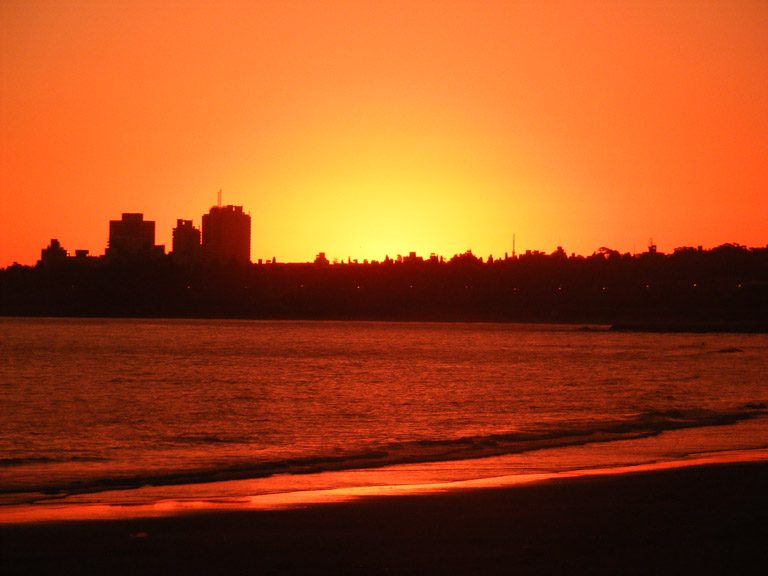
Sunset culture. Montevideo has a relationship with its sunsets over the river that is difficult to explain to someone who has not lived it. From Punta Carretas to Carrasco, starting at 6 p.m. in summer, the Rambla fills with people sitting on the walls watching the sun go down. It is a collective ritual, free of charge, and it is probably the greatest intangible asset of the city.
Running and cycling. The Rambla is Montevideo's longest sports circuit. 22 kilometers one way (44 round trip if you have the fitness). Runners, cyclists, walkers, skaters: at any time of day there are people moving. If you run early or at sunset, living near the Rambla is a real quality-of-life upgrade.
Mate and a bench. It sounds simple, but one of the things Montevideans value most is being able to go downstairs with a thermos and mate, sit on a bench facing the water and spend an hour doing nothing. It is the antidote to urban stress, and it is there every day. This routine works exactly the same whether you live on the Rambla or five blocks away.
The beaches (with nuances). Not all of Montevideo's beaches are equal. The IMM regularly monitors water quality, and results vary significantly from one stretch to another and from one time to another. In general, the eastern beaches (Malvín, Buceo, Carrasco) tend to have better water quality than the western ones (Ramírez, Pocitos in some stretches). After heavy rain, quality drops across the entire coast due to stormwater drains. If the beach matters to you, check the Intendencia's reports before deciding on a neighborhood.
5) Orientation, Floor Plan and Floor Level: What Matters More Than the Address
A frequent mistake is focusing only on "near the sea" without thinking about how the apartment is oriented and laid out. On the coast, these details matter twice as much.
The golden rule of coastal orientation
In Montevideo, the best orientation is north or northeast: it gives you sunlight most of the day all year round. An apartment on the Rambla with an exclusively south-facing front gives you sea views but little sun in winter and direct wind. The ideal combination is dual orientation: sea-facing (south) for the living area and north-facing for bedrooms. Those apartments exist, but they are the most expensive and the first to sell.
High floor vs. low floor
In a building on the Rambla, the difference between the third floor and the tenth floor is enormous. The high floor gives you:
- Views above the trees and traffic.
- Less street noise.
- More breeze (welcome in summer and not so much in winter).
- Better natural light.
The low floor on the Rambla gives you traffic noise, partial views (often you only see trees or the neighboring building's railing) and more concentrated humidity. If you are going to pay the first-line premium, make sure the floor justifies the investment.
Cross ventilation
On the coast, cross ventilation is not a luxury: it is a necessity. An apartment with openings on only one front on the Rambla will be humid regardless, because air does not circulate. Look for floor plans that have openings on two opposite fronts. This also gives you the option of closing the south side when the wind is strong while maintaining ventilation from the north.
6) Hidden Costs of Coastal Property: What You Will Spend After Buying
This is a topic that is rarely discussed in the Uruguayan real estate market, and we prefer to be transparent.
Facade maintenance
A building on the Rambla needs more frequent facade maintenance than an interior one. Paint lasts less, joints deteriorate faster, iron railings rust. That is paid through HOA fees or special assessments. When evaluating a building on the Rambla, ask for the building's maintenance history and the balance of the reserve fund. If they have no significant reserve fund and the facade has gone more than 8 years without intervention, prepare for a special assessment.
Air conditioners
The outdoor unit of a split AC in a building on the Rambla receives direct salt air. Useful life is reduced and maintenance becomes more expensive. Budget for outdoor condenser cleaning at least twice a year (during heavy-use season) and a useful life 20-30% shorter than nominal. It is not dramatic, but it is a cost that adds up.
Windows and frames
Windows on the Rambla work harder: more wind, more pressure, more salt air in the tracks and seals. If the building has old aluminum frames, you will have air and water infiltration. Replacing windows in a three-room apartment can cost between USD 3,000 and USD 8,000 depending on the type (standard aluminum vs. DVH with thermal break). It is an investment worth making if you plan to stay: it improves comfort and reduces heating/cooling costs.
Higher HOA fees
As a general rule, buildings on the Rambla have HOA fees 15-25% higher than comparable buildings four or five blocks away. This is explained by 24-hour concierge (more common on the Rambla), higher frequency of exterior maintenance, more expensive insurance and, in buildings with amenities, pool and gym costs. Always verify the actual HOA amount before making an offer. To understand what they include and how they are calculated: HOA fees: what they include and how they are calculated.
7) Checklist for Evaluating a Coastal Property
When you visit a property near the Rambla, keep this list in your head (or on your phone):
In the apartment
- Windows: open and close all windows. Do they seal properly? Are the tracks clean or corroded? Is there sealed double glazing (DVH)? If there is no DVH, estimate the cost of adding it.
- Humidity: check exterior walls, the inside of wardrobes (especially those against an exterior wall), bathrooms and kitchen. Humidity stains covered with fresh paint are a warning sign: run your hand over the wall and check if it feels cold or damp to the touch.
- Orientation: which way does each room face? Does it get direct sun in winter? Does it have cross ventilation? Visit on a southerly wind day to feel what it is like.
- Noise: if it faces the Rambla, visit during traffic hours (not a Sunday at 10 a.m.). Close the windows and listen. Does noise filter through? How much?
- Air conditioners: where are the outdoor units? Do they look corroded? How old are they? Ask the owner when the last service was done.
In the building
- Facade: look at the building from outside before going in. Are there humidity stains? Peeling paint? Exposed rusted iron on balconies? All of that gets paid through HOA fees.
- Balconies: are they in good condition? Rambla-facing balconies suffer the most. Cracks in the concrete or exposed rebar are expensive repairs.
- HOA fees: ask for the current amount and whether any special assessments are planned. Ask how much is in the reserve fund.
- Management: is there a professional administrator? Are meetings held? Are minutes available? A building on the Rambla without good management deteriorates quickly.
In the neighborhood
- Walk the three surrounding blocks at different times of day. The coast by day and the coast by night can be very different experiences.
- Transport: are there bus stops nearby? How long does it take to get to work from there?
- Services: supermarket, pharmacy, ATM. In Pocitos they are at hand; in Punta Gorda or Carrasco, you may need a car.
If the property is used, add these additional questions: what to ask before buying a used property.
8) The Five Most Costly Mistakes When Buying on the Coast
1. Buying for the view without calculating the total cost. The view is spectacular, but if you add the price premium, the higher HOA fees and the extra maintenance, maybe the math does not work out. Do the full exercise before falling in love: what costs does buying a property involve.
2. Not asking for the actual HOA fee. "It's around 8,000 pesos" is not enough. Ask for the latest receipt. Ask whether increases are planned. Ask about recent or upcoming special assessments. An HOA fee of $15,000 vs. $8,000 is USD 840 difference per year (at the current exchange rate). Over ten years, that is serious money.
3. Ignoring orientation. We said it already, but it bears repeating: south-facing on Rambla = sea views + cold in winter + direct wind. If the apartment has no compensation to the north, you will have a beautiful living room you do not want to use for five months of the year.
4. Not visiting on a southerly wind day. Listings show photos with sun and blue sky. Montevideo has strong southerly wind several days a month, all year round. If you have not visited the property on a bad-weather day, you do not really know what living there is like. Ask for a second visit on a rough day.
5. Dismissing "a few blocks from the Rambla" without having walked it. Many buyers default to "first line" without having walked the three minutes separating the Rambla from the interior streets. Go, time it, feel the difference in wind and noise. Many times, the interior block has everything you are looking for at a price that lets you buy more square meters or better condition.
9) Coastal Living: Who It Suits and Who It Does Not
Coastal living works for you if:
- Outdoor sports are an important part of your routine (you run, walk, cycle).
- You value open space and natural light more than proximity to urban services.
- You have a budget not only to buy but to maintain a coastal property in good condition.
- You are willing to put up with wind and humidity in exchange for the experience.
It may not work for you if:
- Your budget is tight and you need to minimize maintenance costs.
- You work downtown and do not have a car (from Carrasco or Punta Gorda, the commute is long).
- You are very sensitive to cold or humidity and do not want to invest in quality heating and windows.
- You need absolute silence to sleep and the apartment you like faces the Rambla.
Conclusion
Living near the sea in Montevideo is one of the best quality-of-life decisions you can make, if you make it with information. The Montevideo coast has options for very different budgets: from USD 2,900/m2 on Rambla Sur to more than USD 4,400 in Carrasco.
The key is being honest with yourself about what you are buying. If what you want is the view, you need first line and a high floor, and you have to be willing to pay for it (not just in purchase price, but in maintenance, HOA fees and windows). If what you want is the coastal lifestyle — the Rambla, the beach, the sunset, the running — you get that equally three blocks away, for significantly less money and with fewer headaches.
In our experience, most buyers who evaluate both options with the numbers in hand end up choosing the latter. And they do not regret it.
If you are looking for property near the coast and want an assessment with concrete data for the area that interests you, talk to us. It is what we do.
Sources
- Intendencia de Montevideo — Beaches and water quality: montevideo.gub.uy/playas
- Intendencia de Montevideo — Portal: montevideo.gub.uy
- Ministerio de Ambiente (Uruguay): gub.uy/ministerio-ambiente
Related articles
- Living in Pocitos (Montevideo) in 2026: pros, cons, sub-areas and prices
- Living in Buceo (Montevideo) in 2026: pros, cons, sub-areas and prices
- Living in Malvín and Punta Gorda (Montevideo) in 2026: pros, cons and how to choose
- HOA fees: what they include and how they are calculated
- What costs does buying a property involve
- How to evaluate whether a property's price is fair
- What to ask before buying a used property