Living in Punta Carretas, Montevideo (2026): Complete Guide
INGAR · · Neighborhoods
Why Punta Carretas is not "just another coastal neighborhood"
Punta Carretas is, along with Carrasco, one of the two neighborhoods in Montevideo where the price per square meter consistently exceeds USD 3,800. But unlike Carrasco, here everything is walkable: the Rambla, the shopping mall, restaurants, the park, the lighthouse. That combination —premium yet pedestrian-friendly— is what explains why families, professionals, diplomats, and well-off retirees compete for a supply that, compared to Pocitos, is considerably more limited.
If you're considering moving (or investing), this guide gives you what generic portals don't: real sub-zones, up-to-date market data, the history that gives the neighborhood its character, and the things you might overlook if you don't know the area from the inside.
A neighborhood with real history (not just decorative)
Punta Carretas gets its name from the rocky outcrop that marks the southernmost point of Montevideo Bay, where carts (carretas) trying to skirt the coastline historically got stuck. That geographical feature ended up giving its name to the entire neighborhood.
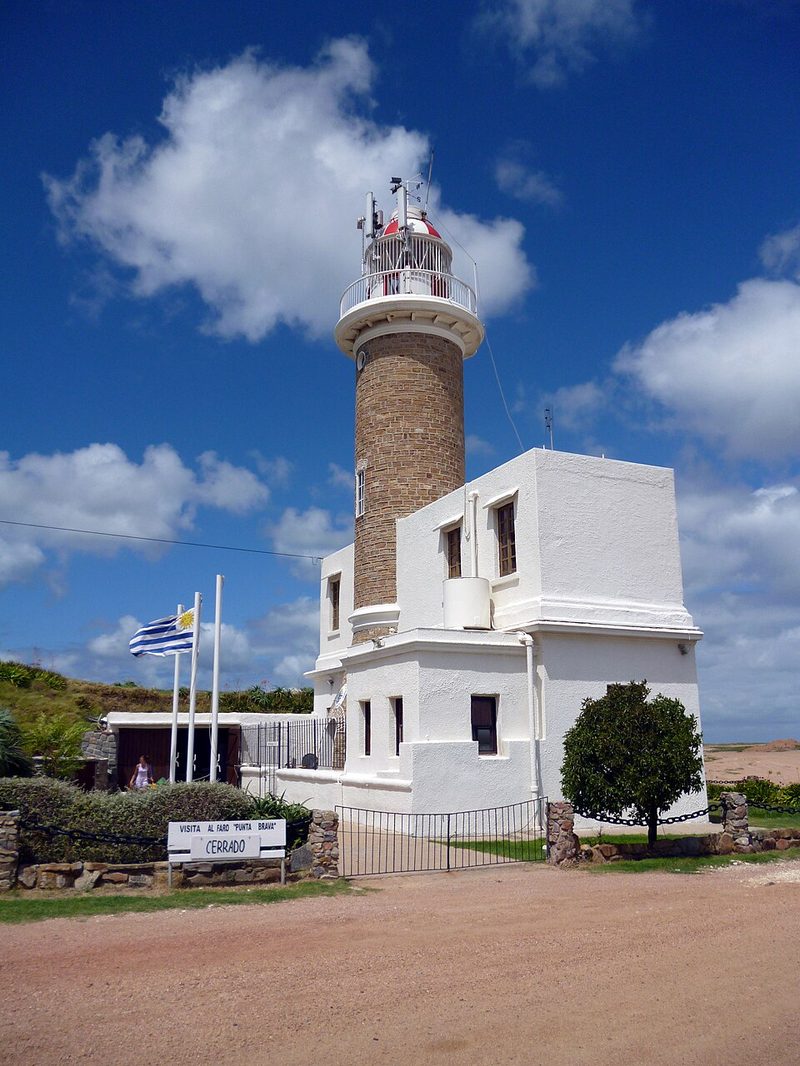
The Punta Carretas Lighthouse (1876)
The Punta Brava Lighthouse —as it is officially known— was inaugurated in 1876 and is still operational. Standing 21 meters tall with a range of 15 nautical miles (about 28 km), it guides navigation toward the Puerto del Buceo and the entrance to the Río Santa Lucía. It was electrified in 1962 but retains its original mechanism. Today it can be visited, and you can climb up to the cupola for panoramic views of the Río de la Plata and the Montevideo coastline. For residents, it is a daily landmark: the lighthouse esplanade is one of the best places in the city to watch sunsets.
From maximum-security prison to shopping center
The neighborhood's most singular history is the transformation of the Penal de Punta Carretas into the current Punta Carretas Shopping mall. Construction of the prison began in 1896 (originally intended as a women's jail) and it opened as a men's penitentiary in 1915, designed by architect Domingo Sanguinetti.
Two events marked its prison history. On September 6, 1971, more than a hundred Tupamaro MLN members and militants from other groups escaped through a tunnel that reached a neighboring house: it was one of the largest prison breaks in world history. And in 1986, a violent riot with six deaths led President Sanguinetti's government to close the prison and transfer inmates to the Penal de Libertad.
The conversion was led by Argentine architect Juan Carlos López and Uruguayan Casildo Rodríguez. The mall opened in 1994, preserving the entrance arch and the original prison facade. Beyond the anecdote, the urban impact was enormous: during the prison era, the area was unsafe and people avoided it. The mall's opening attracted businesses, high-income residents, and revitalized the entire surroundings. Today it is the second most visited shopping mall in the country.
Villa Biarritz: the green heart of the neighborhood
Villa Biarritz Park is the social lung of Punta Carretas. Located at the intersection of José Ellauri and 21 de Septiembre, it is a large space with trees, children's play areas, sports courts, and a natural amphitheater. Since 1930 it has hosted the Feria de Villa Biarritz, Montevideo's largest market: on Tuesdays it operates as a farmers' market and on Saturdays it expands with clothing, crafts, plants, street food, and design objects (approximately from 9 a.m. to 2 p.m.). It is a neighborhood ritual with no equivalent anywhere else in the city.
The Golf Club
Founded in 1922, the Club de Golf del Uruguay occupies 39 hectares in the very heart of Punta Carretas. Its 18-hole course (6,635 yards) was designed by Alister MacKenzie —the same architect behind Augusta National, where the Masters is played— and was declared a National Historic Monument in 1975. For the neighborhood, the club functions as an enormous private park that maintains a bubble of greenery and quiet unthinkable for such a central area. Properties bordering the golf course or with views of the fairways command a significant premium.
Sub-zones: what changes block by block
Punta Carretas is not uniform. There are real differences in price, noise, resident profile, and real estate supply depending on where you are. Before filtering by "neighborhood" on a portal, decide which axis matters most to you.
| Sub-zone | Typical profile | What you gain | What you give up | Indicative price (USD/m²) |
|---|---|---|---|---|
| Rambla (front or first line) | Couples without children, professionals, investors | River views, direct access to the waterfront promenade, maximum appreciation | Constant humidity and wind, most expensive apartments per m², traffic noise on the Rambla | USD 4,200 – 5,500+ |
| Around the Mall / Ellauri | Young professionals, those who want everything nearby | Maximum walkability, shops, transport, urban life | Bustle and noise at peak hours, difficult parking, some blocks with little sun due to towers | USD 3,500 – 4,200 |
| Villa Biarritz (around the park) | Families, professionals working from home, expats | Green space, quiet, weekly market, "small village" feel, good natural light | Limited supply (sells quickly), Saturday market crowds | USD 3,800 – 4,500 |
| Around the Golf Course | Established families, diplomats, high net worth | Maximum quiet, golf course greenery, exclusivity | Top prices in the neighborhood, low stock turnover, far from everyday services | USD 4,000 – 5,000+ |
| Residential interior (secondary streets) | Families, home office, those prioritizing quiet over views | Quiet streets, mix of classic homes and low-rise buildings, relatively good value | Less commercial life, own garage almost essential | USD 3,000 – 3,800 |
Shortcut for choosing a sub-zone
| If your priority is… | Look in… | Avoid… |
|---|---|---|
| Walking to the Rambla every day | First or second line from the Rambla | Low-floor units facing the Rambla (nighttime traffic noise) |
| Home office without interruptions | Rear-facing units on interior streets or around the Golf course | Ellauri, José Ellauri, and corners with bus stops |
| Urban life "everything at hand" | 4–5 block radius of the mall | Units without soundproofing on lower floors |
| Investment with best rental yield potential | 1–2 bedroom units near the mall or the Rambla | Large units on streets with no particular appeal |
Real estate market: prices, supply, and what they don’t tell you
The most important figure: Punta Carretas has an average sale price of around USD 3,800 – 4,000 per square meter, placing it among the most expensive neighborhoods in Montevideo alongside Carrasco, Puerto del Buceo, and Villa Biarritz itself (which is technically part of Punta Carretas but appears separately on portals).
Indicative purchase price ranges (2026)
| Type | Typical range (USD) | Comment |
|---|---|---|
| Studio (30–40 m²) | 95,000 – 140,000 | High demand for rental. Few available with parking. |
| 1 bedroom (45–65 m²) | 130,000 – 230,000 | The most active segment. Large gap based on condition and location. |
| 2 bedrooms (70–100 m²) | 170,000 – 370,000 | The “sweet spot” for small families. Renovated units with parking are the most sought after. |
| 3 bedrooms or more (100+ m²) | 300,000 – 600,000+ | Limited supply. With sea or golf course views, they easily exceed USD 500,000. |
What sets Punta Carretas apart from the rest of the market
- Smaller supply than Pocitos. Pocitos has double or triple the listings on any portal. In Punta Carretas, good units don’t last long. If you wait for “the perfect opportunity,” you’ll be waiting a while.
- Higher HOA fees than average. Many buildings have amenities (pool, gym, 24h concierge) that drive up monthly fees. A 2-bedroom in a tower with services can have fees of UYU 15,000 – 25,000 per month. Always ask for the latest receipt before making an offer.
- Parking as a critical variable. In central buildings, a parking space can represent an additional USD 15,000 – 25,000. Without parking, street parking in commercial hours is challenging. Always calculate the total cost: price + parking + HOA fees.
- New pre-sale developments. Pre-sale developments start at around USD 185,000 for a 1 bedroom and can reach USD 330,000+ when finished. The difference between pre-sale and finished delivery is around 20–30%, creating real opportunities if you can wait.
If you need a methodology for determining whether a price is reasonable: how to evaluate if a property price is fair. And to estimate all purchase costs (notary, taxes, commissions): property purchase expenses.
Rental
If you plan to rent, keep in mind that Punta Carretas competes with Pocitos for upper-middle-class tenants. Rents are in line with or slightly above Pocitos, but with fewer available options. Confirm the accepted guarantee type before reserving —not all landlords accept all guarantees—: rental guarantee guide.
Daily life: what it’s really like to live in Punta Carretas
Neighborhood profile
Punta Carretas is an upper-middle and upper-class neighborhood, with a significant presence of professionals, families, diplomats (several embassies are in the area), and well-off retirees. The Jewish community has a historically important presence in the neighborhood, with synagogues, community centers, and kosher shops. It is a neighborhood where residents know each other —especially in the Villa Biarritz area— and where the atmosphere is peaceful.
Safety
It is consistently one of the neighborhoods with the lowest crime rates in Montevideo. The residential profile, the density of businesses open during the day, the presence of concierges in most buildings, and good street lighting contribute to a sense of security that is real, not merely perceived. This doesn’t mean you shouldn’t take the usual precautions, but the difference from other parts of the city is tangible.
Restaurants and services
The dining scene is varied and of a high standard. Outside the mall (which has its own food court and restaurants), the Ellauri and 21 de Septiembre area concentrates cafés, bistros, and restaurants ranging from classic parrilla to modern cuisine. Places like La Pulpería (where many consider you’ll find the best asado in the area), El Viejo Sosa (outstanding value), and Negroni Café Bistró (cocktails and fusion dishes) are local references. For daily shopping, there are supermarkets, artisan bakeries, greengrocers, and everything you need without leaving the neighborhood.
Nightlife: an honest take
If you’re looking for nightlife, Punta Carretas is not your neighborhood. After 10–11 p.m., most streets are quiet. There are some bars and restaurants that stay open late, but the intense nightlife is in Pocitos, Ciudad Vieja, or Parque Rodó. For many residents, this is exactly what they’re looking for: quiet nights. If you want nightlife, Pocitos is a 10-minute walk away.
Education
For families with children, the educational offer is a strong point. In the neighborhood and its surroundings, top-tier private schools operate: Saint Brendan’s School (the only school in Uruguay authorized to offer all three International Baccalaureate programs), the Colegio y Liceo Juan Zorrilla de San Martín, Colegio Punta Carretas (bilingual, non-religious), and several other options. The concentration of good schools in the area is one of the main reasons so many families choose this neighborhood.
The Rambla: it’s not a detail, it’s a lifestyle
The Punta Carretas Rambla is arguably the most beautiful stretch of the entire Montevideo waterfront. From the lighthouse to Playa de los Pocitos, the route combines rocks, esplanades, small beaches, and open views of the Río de la Plata. Walkers, runners, cyclists, people drinking mate at sunset: the Rambla is the neighborhood’s living room. Living a few blocks from this Rambla changes everyday life in a way that’s hard to quantify until you experience it.
Mobility, transport, and parking
By car
Punta Carretas has good vehicle connectivity. The Rambla takes you to Pocitos, Buceo, and Ciudad Vieja without complications outside peak hours. Bulevar Artigas connects you to the WTC area and the city center in minutes. The problem is parking: in the mall and Ellauri area, finding a street spot during business hours is a battle. If your building doesn’t have parking, this is a cost you need to factor in (renting a space or dealing with the inconvenience).
By bus
Several lines cross the neighborhood: 116, 192, 328, 582, 76, and DM1, among others. The main stops are on José Ellauri, 21 de Septiembre, and the streets bordering the mall. Frequency is acceptable, but if you work far away (Carrasco, Zona América, for example), the combination of lines may not be ideal. Try the commute during peak hours before signing a lease.
By bicycle
The area has a bike lane and the terrain is reasonably flat. Reaching Pocitos, Parque Rodó, or the city center by bicycle is feasible and many residents do it daily. The proximity to WTC Montevideo makes the bike + work combination viable for those working in the Buceo office district.
On foot
It is one of the most walkable neighborhoods in Montevideo. If you live within a 6–7 block radius of the mall, you can handle almost everything without a car: supermarket, pharmacy, bank, restaurants, park, Rambla. This walkability is one of the great differentiators from Carrasco, where you can’t do anything without a car.
Punta Carretas vs. Pocitos: a real comparison
They are neighbors and many people confuse them, but the differences are clear:
| Aspect | Punta Carretas | Pocitos |
|---|---|---|
| Pace | Residential, quiet at night | More urban and lively, with more nightlife |
| Price/m² | ~USD 3,800–4,000 average | ~USD 3,200–3,600 average |
| Available supply | Limited (sells faster) | Extensive (the largest in Montevideo) |
| Walkability | Excellent | Excellent |
| Parking | Difficult near the mall | Difficult in general (higher density) |
| Nightlife | Minimal | Moderate (bars, restaurants open late) |
| Green space | Villa Biarritz + Golf (39 ha) | Plaza Gomensoro, fewer m² of green per capita |
| Resident profile | More established (families, diplomats) | More diverse (young people, students, families) |
| Private schools | High concentration (Saint Brendan’s, etc.) | Good, but more spread out |
| Buildings | Mix of classic houses and modern towers | Predominantly towers and multi-story buildings |
The key: if you prioritize peace, green space, and exclusivity, choose Punta Carretas. If you prioritize variety, urban life, and more purchase/rental options, choose Pocitos. There is no universal winner. Complementary guide: living in Pocitos.
Property types: what you’ll find
- Classic houses. On interior streets and in the Villa Biarritz area, houses from the 1940s–60s survive, many with gardens. Some have been renovated, others retain their original state. They are coveted by families looking for character, but maintenance can be costly and the land is highly valued (which tempts developers to demolish and build towers).
- Mid-rise buildings (6–10 floors). The majority of the neighborhood’s supply. Constructions from the 1970s–90s, with spacious apartments, good layouts, and in many cases, included parking. HOA fees vary greatly depending on the building’s services.
- Modern towers (15+ floors). The most recent developments, with amenities (pool, gym, rooftop, co-working). They target buyers willing to pay high HOA fees in exchange for services. Views from upper floors —especially facing the sea or the Golf course— are a strong selling point.
- New/under-construction developments. There are new projects, but fewer than in Pocitos or Buceo. Pre-sale is an attractive option if you can wait 18–24 months, with significant price differences compared to the finished unit.
If you’re evaluating a used property, don’t skip this review: used property purchase checklist.
For investors: does Punta Carretas deliver returns?
The short answer: rental yield is moderate (4–5% gross annual), but capital appreciation is consistent. Punta Carretas is not a neighborhood for speculating on high yields —for that, look at more accessible neighborhoods— but it is a neighborhood where capital is well preserved and vacancy is low.
The most interesting units for investment are:
- 1 bedroom near the mall or the Rambla: high rental demand from single professionals or young couples.
- 2 bedrooms with parking in the Villa Biarritz area: stable demand from small families, good value retention.
- Pre-sale in new developments: if you buy early, the difference between pre-sale price and finished resale price can be 20–30%.
Pros and cons: no sugarcoating
What makes Punta Carretas hard to beat
- Exceptional walkability: Rambla, park, mall, schools—all on foot.
- Real safety, not just perceived. One of the neighborhoods with the least crime in Montevideo.
- Mix of green and urban: Villa Biarritz + 39 hectares of Golf course + Rambla.
- Top-tier educational offer concentrated within a few blocks.
- Coastal Rambla as an extension of your living room: sunsets, walks, mate, sport.
- Full range of shops and services without needing to leave the neighborhood.
- Stable community: residents don’t turn over often, which creates a sense of belonging.
- Proximity to WTC and the Buceo office district (10 min by car, 20 by bike).
What you have to accept if you choose Punta Carretas
- High total cost. It’s not just the price per m²: add HOA fees (which in towers with amenities can be significant) and parking. The real monthly cost can be 20–30% more than just the rent or mortgage payment.
- Limited supply. If you’re looking for something very specific (3 bedrooms with parking, good orientation, near Villa Biarritz), the search can take months.
- Complicated parking. In the mall and Ellauri area during daytime hours, it is a real source of frustration.
- Almost no nightlife. If you’re between 25 and 35 and go out often, you’ll be depending on Pocitos or Ciudad Vieja.
- Coastal wind and humidity. Rambla front-line apartments receive constant southeast wind. This affects paint, windows, and balcony comfort. It’s not a major problem, but it is an additional maintenance cost that many don’t factor in.
- Noise on main streets. Ellauri, 21 de Septiembre, and the Rambla itself have significant traffic. If you’re sensitive to noise, avoid low floors facing these streets.
Mistakes we see repeated
- Buying “for the name” without walking the block. Punta Carretas has very different zones. Living across from the Golf course is not the same as living on Ellauri. Visit the exact block at different times of day before making an offer.
- Underestimating HOA fees. A building with a pool, gym, and 24h concierge can have monthly fees equivalent to a rental in other neighborhoods. Always ask for the latest receipt and ask about any planned works that could generate extraordinary charges (HOA fees guide).
- Ignoring orientation. In an area with many towers, the apartment’s orientation and floor height directly impact natural light and ventilation. A south-facing apartment on a low floor can be dark and damp.
- Not verifying the guarantee type before reserving. If you’re renting, confirm that the landlord accepts your guarantee before reserving the unit. Not all options are accepted (rental guarantees).
- Comparing only by listed price. The listed price doesn’t include purchase costs: notary, ITP, registration and, if a real estate agency is involved (the usual case), its 3% + VAT commission. With an agency they add 8–10% on top; without an intermediary, 5–6%. Always do the full calculation (purchase costs).
Checklist for making the right choice in Punta Carretas
- Define your priority sub-zone (Rambla, Villa Biarritz, Golf, interior, mall area).
- Decide whether parking is a non-negotiable requirement or something you can resolve another way.
- Ask for the latest HOA receipt and inquire about planned works.
- Visit the property at least twice at different times (weekday morning and evening/night).
- If it’s used: check for dampness, condition of electrical and plumbing installations, and age of the elevator (full checklist).
- If renting: confirm the accepted guarantee type before reserving.
- Calculate the real monthly total: rent/mortgage + HOA fees + parking + utilities.
- If buying, compare with at least 5 similar properties in the area and use USD/m² as your base metric.
- Test the commute to your workplace during peak hours (by car and/or public transport).
- If you have children: verify the walking distance to the chosen school and check pedestrian safety along the route.
Is Punta Carretas right for you?
Yes, if: you’re looking for a neighborhood where everything is walkable, you prioritize peace without giving up services, you want the Rambla and green space in your daily life, you have (or plan to have) children and value the educational offer, and your budget accommodates the total cost (not just the purchase or rental price).
Probably not, if: your budget is tight and you need to maximize square footage, you need nightlife nearby, you depend on a car and can’t pay for parking, or you prefer a neighborhood with more turnover and supply options.
In any case, the decision depends on your specific situation. If you’d like us to help you evaluate options in Punta Carretas (or in other neighborhoods that might work for you), contact us and let’s talk with no obligation.
Sources
- Municipio B – Punta Carretas (neighborhood reference): municipiob.montevideo.gub.uy
- Intendencia de Montevideo – Club de Golf del Uruguay: montevideo.gub.uy
- Intendencia de Montevideo – Beaches and locations: montevideo.gub.uy
- InfoCasas – Price per square meter report in Montevideo: infocasas.com.uy
- Wikipedia – Punta Brava Lighthouse: wikipedia.org
- Municipio B – Geographic boundaries: municipiob.montevideo.gub.uy
Related articles
- Living in Pocitos (Montevideo) in 2026: pros, cons, sub-zones and prices
- Living near the sea in Montevideo (2026): accessible areas, pros/cons and checklist
- The best areas for families with children in Montevideo (2026): criteria and shortlist
- How to evaluate if a property price is fair
- What costs are involved in buying a property in Uruguay